
Why desalination is becoming critical for industrial water supply
Desalination plants in Spain are becoming a critical part of water infrastructure, driven by water scarcity, industrial demand, and increasing climate pressure. What was once considered a niche solution is now evolving into a core pillar for securing water supply, both for municipalities and for large-scale industrial projects.
This shift is further reinforced by the rapid growth of water-intensive industries such as data centers, semiconductor manufacturing, energy, and advanced industrial processes, where reliable access to large volumes of water is becoming a strategic requirement.
At the center of this transformation are reverse osmosis technologies. Their rapid adoption is explained by a combination of factors: significantly lower energy consumption compared to thermal desalination, strong scalability for industrial applications, and continuous improvements in membrane performance.
Desalination Plants in Spain: Locations, Drivers and Infrastructure
A geographically driven market
Spain offers a particularly relevant case study, as one of the most advanced desalination markets in Europe. With over 700 desalination plants across the country, capacity is largely concentrated in coastal regions where water stress is most acute.
The main clusters are located in:
- Murcia, Alicante, and Almería
- Catalonia (Barcelona area)
- The Canary Islands
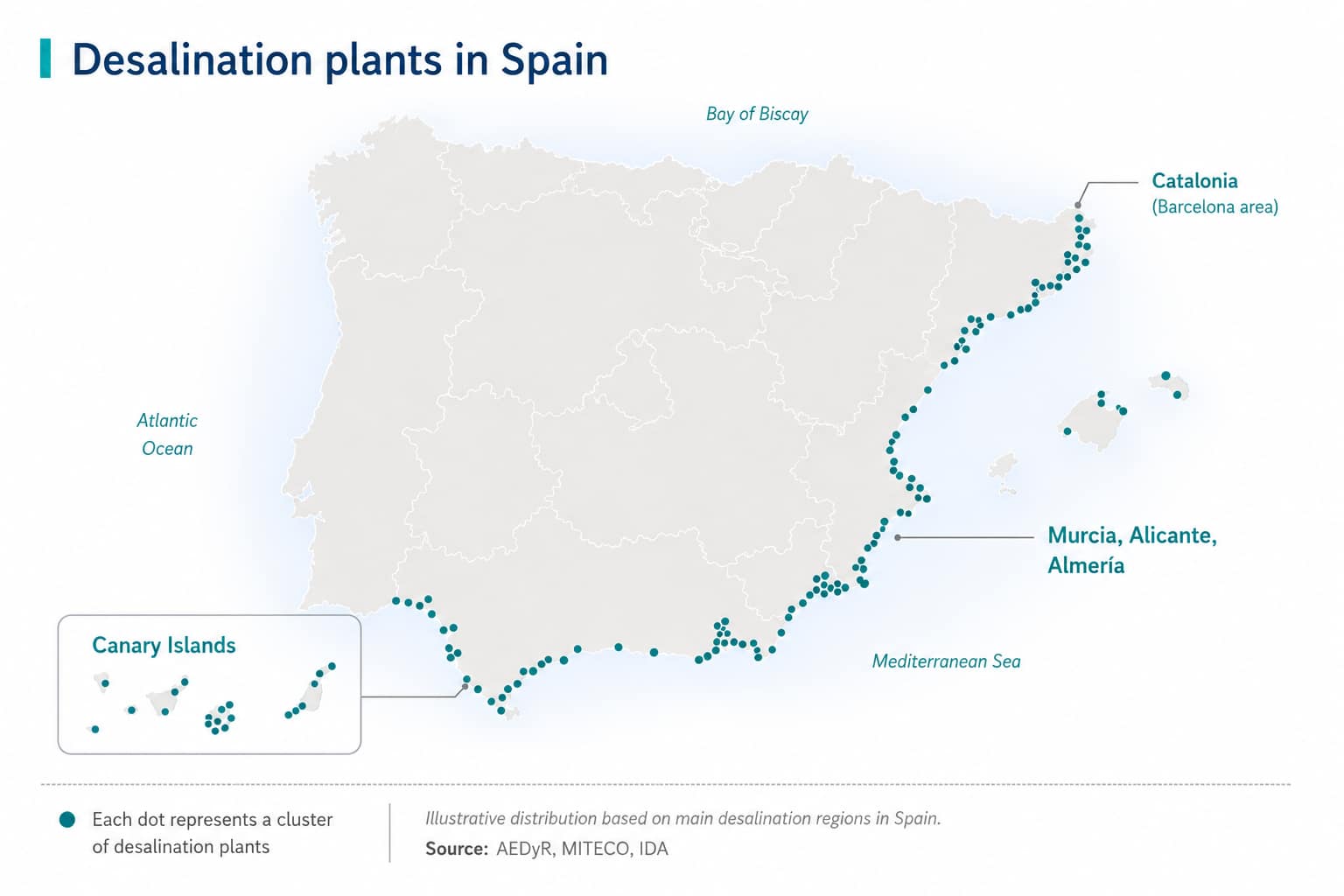
This distribution reflects a combination of structural constraints and economic drivers. The southeast of Spain faces chronic water scarcity, while agricultural demand remains high. Seasonal pressure from tourism further increases water needs, and freshwater resources are often limited or overexploited.
In this context, desalination has become an integral part of the national water strategy. Unlike other regions, Spain does not rely on desalination as a standalone solution, but integrates it within a broader system combining water reuse, reservoirs, and groundwater management.
Middle East: the global benchmark for desalination scale
If Spain represents a mature and integrated model, the Middle East illustrates desalination at its maximum scale.
In countries such as Saudi Arabia and the United Arab Emirates, desalination is not a complementary solution but the backbone of water supply. Entire national systems depend on it to meet both domestic and industrial demand.
This is reflected in several key characteristics:
- Very large-scale infrastructure
- Strong integration with energy systems
- A rapid transition from thermal desalination to reverse osmosis
- Strategic importance for national water security
In this context, desalination becomes not only an engineering challenge but also a geopolitical one.
United States: selective desalination and industrial applications
The United States presents a different approach. Here, desalination is deployed more selectively and is typically integrated into a diversified water management strategy.
It is mainly used in water-stressed regions such as California, Texas, and Florida, often in combination with water reuse and recycling systems.
This model is shaped by economic and environmental considerations:
- Desalination competes with alternative solutions such as reuse or groundwater extraction
- Projects are highly sensitive to cost
- Industrial applications play a significant role
As a result, desalination in the US is not a default solution, but one option among several, selected based on local constraints.
Key trends in desalination and reverse osmosis technologies
Energy efficiency as the main constraint
As desalination scales globally, its main limitation becomes clear: energy consumption.
Energy represents the largest share of operating costs in desalination plants. Typical seawater reverse osmosis systems operate in the range of 3 to 4 kWh per cubic meter, making efficiency a central design parameter.
At the same time, desalination also raises environmental challenges. Brine discharge, in particular, can affect marine ecosystems if not properly managed, due to increased salinity and chemical residues.
These combined constraints, energy and environmental impact, are shaping the evolution of the sector. The industry is now focusing on:
- Energy recovery systems (ERDs)
- High-efficiency membranes
- Integration with renewable energy
Energy efficiency is therefore no longer just a technical improvement, but a key factor in the long-term viability of desalination projects.
Increasing complexity of membrane systems
In parallel, desalination systems themselves are becoming more complex.
Modern plants no longer rely on a single technology, but combine multiple membrane processes:
- Reverse Osmosis (RO)
- Nanofiltration (NF)
- Ultrafiltration (UF)
UF and NF are typically used as pretreatment stages, improving feed water quality and protecting reverse osmosis membranes. This enables more stable operation and higher overall system performance.
The objective is to increase water recovery, reduce energy consumption, and minimize environmental impact. However, these improvements introduce new operational constraints.
As recovery rates increase, the remaining brine becomes more concentrated. Higher salinity levels increase the risk of scaling and fouling if not properly controlled, making brine management a critical aspect of system design.
This is driving interest in optimized configurations, higher-recovery systems, and emerging approaches to brine management and resource recovery.
Industrial demand is accelerating growth
Beyond technological evolution, demand itself is also shifting.
Desalination is increasingly used outside traditional municipal applications, particularly in industrial sectors such as:
- Hydrogen production
- Energy and petrochemicals
- Semiconductor manufacturing
- Data center cooling
These applications require reliable, high-quality water at scale, often in locations where conventional resources are limited.
This shift is accelerating the need for engineers who can operate at the intersection of membrane technologies, industrial processes, and large-scale project execution.
Why reverse osmosis and membrane technologies are improving efficiency
At the core of these developments lies continuous innovation in membrane technologies.
Modern reverse osmosis systems operate under optimized pressure conditions, integrate advanced energy recovery devices, and benefit from improved hydraulic design. Together, these factors significantly reduce energy consumption.
At the same time, advances in membrane selectivity and resistance to fouling allow higher recovery rates while maintaining performance, reducing both operational costs and environmental impact.
These improvements are particularly critical in large-scale industrial projects, where efficiency and reliability directly impact project viability.
Spain as an engineering hub for desalination projects
Within this global landscape, Spain has developed a strong position as an engineering hub for desalination.
The country combines:
- High expertise in EPC and industrial project execution
- Proven experience in reverse osmosis technologies
- Strong international exposure, particularly in Europe, the Middle East, and Latin America
While it does not match the scale of the Middle East, Spain stands out for its technical maturity, diversity of projects, and ability to integrate desalination within complex water systems.
Why this matters for engineering talent
As the sector evolves, so does the demand for engineering profiles.
Desalination projects increasingly require:
- Process engineers specialized in RO, NF, and UF systems
- Mechanical and piping engineers
- Project managers with EPC/EPCM experience
- Specialists in energy optimization
As water scarcity becomes a structural global issue, desalination is emerging as a long-term growth sector, offering both technical challenges and international opportunities.
Conclusion
Desalination and reverse osmosis are no longer niche technologies. They are becoming a structural component of global water infrastructure.
Spain stands out as a mature and technically advanced market, combining strong engineering capabilities with international project exposure. At the same time, regions such as the Middle East and the United States illustrate how different constraints, from scale to cost sensitivity, shape distinct deployment models.
As demand continues to grow, the challenge is no longer only to produce water, but to do so efficiently, sustainably, and at scale. This is where engineering expertise, particularly in membrane systems, energy optimization, and integrated plant design, becomes critical.
For experienced engineers, desalination is not just a growing sector. It is a field where technical complexity, global exposure, and long-term relevance are converging.
